Stairlifts and home elevators both help you move safely between floors. They work differently and cost different amounts. Each works better for different people. Here is what you need to know before choosing.
A chair lift for stairs has a motorized seat that attaches to your existing staircase. It lets you go up and down without walking the steps. A home elevator has a small cab that moves up and down inside a built shaft.
Both help people move between floors in a house, but the two options are very different.
Key differences include:
- Cost
- Space needed
- Installation time
- Wheelchair use
- Home value
A recent AARP survey shows that about 71% of older adults in the United States want to stay in their own homes. Most do not want to move to assisted living. The National Aging in Place Council (NCOA) and the American Occupational Therapy Association (AOTA) say stairs are a main reason seniors have to leave their homes. Stair lifts and home elevators are two common solutions.
This guide compares chair lifts and home elevators using 8 factors: cost, space, installation time, wheelchair use, weight capacity, maintenance, noise, and home value. It helps you choose the best option for your home.
What Is a Chair Lift for Stairs?
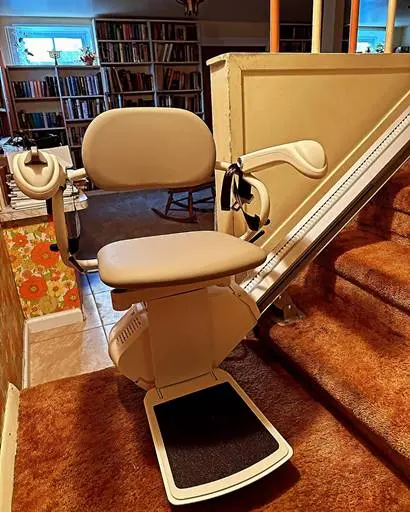
A stairlift, also called a chair lift, is a motorized chair on a rail attached to the steps of a staircase, not the wall.
The user can:
- Sit on the seat.
- Fasten a seat belt.
- Press a button or move a joystick to ride smoothly up or down the stairs.
The seat, footrest, and armrests fold up when not in use. This keeps the stairs clear for other people.
Stairlifts come in two main types based on staircase shape:
- Straight stairlifts – for single, straight flights. They install fastest and cost the least.
- Curved stairlifts – for stairs with bends, L-shapes, or landings. The rail is custom-made, which raises cost and installation time.
Leading stairlift brands include Bruno Independent Living Aids, Acorn Stairlifts, Stannah, Savaria, and Harmar (makers of the Pinnacle series). Each brand offers models with different weight limits, seat widths, upholstery, and safety features.
Stairlift Pros:
- Installs in 3–4 hours without changing the stairs.
- Much cheaper than home elevators.
- Works on most stairs, straight or curved.
- Other people can still use the stairs.
- Can be moved or taken if you move.
- Some grants or financial help may be available.
Stairlift Cons:
- Not good for people who stay in a wheelchair full-time without help.
- Can hold less weight than a home elevator.
- Homes with more than one level need a stairlift for each staircase.
- Limited styles and finishes to choose from.
- Does not increase home value.
- Narrow stairs may need the railing removed.
What Is a Home Elevator?
A home elevator is a small, enclosed cab that moves up and down between floors. It works like a commercial elevator but is made for 1 or 2 people.
Home elevators fit into a home’s layout and let users travel between all floors. Wheelchair users can ride without transferring to another device.
There are four main types of home elevators:
- Hydraulic elevators – Use fluid-driven pistons for a smooth ride. Require a small machine room next to or below the shaft.
- Traction (cable) elevators – Use an electric motor and cables over pulleys. Can travel higher but make more noise.
- Vacuum (pneumatic) elevators – Move a clear plastic cylinder cab using air pressure. Take up less space and need no shaft, but cost more.
- Through-floor elevators – Lower-cost option for two floors. Do not need a traditional hoistway.
Major home elevator makers include ThyssenKrupp Access, Otis Elevator Company, Savaria, and Vantage Mobility International (VMI). Most elevators can be customized. You can choose the cab finish, door style, control panel, and lighting to match your home.
Home Elevator Pros:
- Full wheelchair and mobility scooter access, no transfer needed.
- One device works for all floors.
- Can increase home value.
- Can hold more weight than stairlifts.
- Custom cab design, finishes, and doors.
- Can carry heavy items between floors.
- Has emergency features like lighting, phone, and manual lowering.
Home Elevator Cons:
- Much more expensive than stairlifts.
- Needs changes to the house and a special shaft.
- Installation takes days or weeks, not hours.
- Some homes cannot fit an elevator.
- Needs more maintenance because of many moving parts.
- Must follow building codes and get permits.
Chair Lift vs Home Elevator: Side-by-Side Comparison
| Factor | Chair Lift (Stairlift) | Home Elevator |
| Installed Cost | $3,000–$15,000 | $10,000–$100,000+ |
| Installation Time | 3–4 hours (straight); 1–2 days (curved) | Several days to 2 weeks |
| Structural Changes | None needed | Needed, shaft and floor openings |
| Minimum Space | Existing staircase (28–30 in / 71–76 cm wide) | 12–18 sq ft (1.1–1.7 m²) shaft area |
| Wheelchair Use | No, transfer required | Yes, roll in and out directly |
| Weight Capacity | 250–400 lbs (113–181 kg) | 750–1,000 lbs (340–454 kg) |
| Multi-Floor Access | One staircase per unit | All floors from one device |
| Home Value | Minimal or none | Positive, adds property value |
| Noise Level | Low | Moderate to high (depends on type) |
| Annual Maintenance | One service visit per year | Yearly + 5-year full inspection |
| Permit Required | Usually no | Yes, in most U.S. areas |
| Can Move to Another Home | Yes | No |
Cost: Chair Lift for Stairs vs Home Elevator
Cost is the main factor for most households. Here are four price levels to know when planning for stairway access:
| Type | Cost Range | Notes |
| Straight Stairlift | $3,000–$5,000 | Most common type; includes installation; used/refurbished units start around $2,200; brands: Bruno, Acorn, Harmar Pinnacle |
| Curved Stairlift | $8,000–$15,000 | Made for stairs with bends, L-shapes, or half-landings; custom rails increase cost |
| Standard Home Elevator | $10,000–$50,000 | Basic unit: $10,000–$30,000; installation adds $5,000–$20,000+; hydraulic or cable-driven models |
| Premium Home Elevator | $35,000–$100,000+ | Luxury models (pneumatic or high-end hydraulic); fully installed; may cost less than a year of assisted living ($50,000–$100,000) |
Financial Aid for Stairlifts
Stairlifts can qualify for some grants and financial help. This includes Medicaid Home and Community-Based Services (HCBS) waivers in certain U.S. states. Veterans can get help through the VA Specially Adapted Housing grants. Local aging-in-place programs run by Area Agencies on Aging may also help.
Home elevators usually do not qualify for public grants. However, in some cases, the cost may be used as a medical expense deduction on taxes.
It is best to talk to a certified aging-in-place specialist or an occupational therapist. They can tell you which programs are available in your state.
Space Requirements
Available space often determines which option is physically possible for a given home.
How Much Space Does a Stairlift Need?
Space is an important factor when choosing a stairlift for your home.
- Mounts directly onto existing staircase treads.
- Minimum stairway width: 28–30 in (71–76 cm).
- Fits standard U.S. residential stairwells (Harmar Pinnacle, Bruno, Acorn).
- Seat, armrests, and footrest fold flat.
Stairlifts attach to the stairs without major changes to your home. When not in use, the folding parts keep the stairs usable for other household members.
How Much Space Does a Home Elevator Need?
Available space is often the main limit when installing a home elevator.
- Smallest cab: ~12 sq ft (1.1 m²).
- Standard cab: up to 18 sq ft (1.7 m²).
- Hydraulic and cable-driven elevators need extra space for the motor/mechanical room (below or adjacent).
- Pneumatic vacuum elevators have a smaller shaft but still need more floor space than a stairlift.
- Requires enough vertical clearance above and below cab travel.
Home elevators take up more room than stairlifts and need a dedicated shaft. Planning carefully ensures safe and efficient installation.
Space Rule of Thumb:
A home that cannot dedicate 12–18 sq ft (1.1–1.7 m²) to an elevator shaft is likely better served by a stairlift.
If space is tight but full wheelchair access is needed, a through-floor elevator can be considered. This type of elevator does not need a traditional hoistway. It can be a good middle option between a stairlift and a full home elevator.
Wheelchair Compatibility: The Clearest Deciding Factor
Wheelchair access is one of the most important things to consider when choosing between a stairlift and a home elevator.
Stairlifts:
- Not suitable for full-time wheelchair or powerchair users without help.
- Users must transfer from wheelchair to stairlift seat, ride, then transfer back.
- Requires enough upper body strength and the ability to stand and pivot.
- Can be risky for anyone who cannot transfer independently.
Home Elevators:
- Fully compatible with wheelchairs and mobility scooters.
- The user rolls into the cab, presses a button, and rolls out on the next floor.
- No transfers needed at any point.
- Recommended by AOTA and NCOA for wheelchair users.
For anyone who needs full wheelchair access, a home elevator is the safer and more convenient option.
Installation: Time, Process, and Disruption
The installation process and how long it takes can make a big difference when choosing between a stairlift and a home elevator.
Stairlift Installation:
- Straight stairlift: 3–4 hours by a certified technician
- Curved stairlift: 1–2 days (custom rail must be made first)
- Usually no permits, contractors, or major structural work needed
- Home remains fully usable the same day
Home Elevator Installation:
- Takes several days to 2 weeks or more
- Depends on elevator type, new shaft construction, and local building codes
- Often involves an architect, licensed contractor, and sometimes a structural engineer
- Permits required in most U.S. areas
- Shaft area is inaccessible; parts of the home may experience major disruption
Stairlifts are much faster and less disruptive to install, while home elevators require more time, planning, and construction.
Noise
Sound during use is another factor to consider when choosing between a stairlift and a home elevator.
Stairlifts:
- Most modern models (Bruno, Acorn, Stannah, Harmar) are very quiet
- Noise is low enough to have a normal conversation during a ride
Home Elevators:
- Generally louder than stairlifts
- Pneumatic vacuum elevators are among the quieter options
- Cable-driven and hydraulic elevators make more mechanical noise
- Acoustic insulation panels can reduce noise but increase installation cost
Stairlifts are usually the quieter choice, while home elevators may require extra measures if noise is a concern.
Maintenance
Regular maintenance is important for both stairlifts and home elevators, but the effort and cost are different.
Stairlift Maintenance:
- Lubricate track, inspect motor and drive system
- Test safety sensors and check battery backup
- One annual service visit covers most needs
- Simple design = fewer problems and lower cost per visit
- Battery backup usually replaced every 2–3 years
Home Elevator Maintenance:
- Annual service plus a full inspection every 5 years
- Hydraulic systems need fluid checks; cable systems need tension and pulley inspection
- All systems require cab, door, safety phone, and emergency lighting checks
- More moving parts = higher maintenance cost and higher risk if upkeep is delayed
Stairlifts are easier and cheaper to maintain, while home elevators need more attention and cost to keep running safely.
Impact on Home Value and Resale
How a stairlift or home elevator affects your home’s value is important if you plan to sell in the future.
Stairlift:
- Usually does not increase property resale value
- Many buyers, especially younger ones, are not looking for a home with a stairlift
- Some sellers remove stairlifts before listing the home
Home Elevator:
- Can add measurable resale value, especially in higher-value homes or markets with older buyers
- Value added depends on elevator type, design, and overall home condition
- Some data suggests a home elevator can offset its installation cost when compared to annual assisted living fees ($50,000–$100,000 per year in the U.S.)
A well-chosen home elevator can improve resale value, while stairlifts generally do not affect home price.
Who Should Choose a Chair Lift for Stairs?
A stairlift is best in these situations:
- The person can walk short distances and move from a wheelchair or walker to the seat with little help
- The budget is limited, $3,000–$15,000 is much cheaper than $10,000–$100,000 for a home elevator
- The home cannot support an elevator shaft or does not have 12+ sq ft (1.1+ m²) for an elevator
- A fast solution is needed, such as after surgery or a sudden change in mobility, without long construction
- A temporary or medium-term solution is needed that can be removed or moved later
Stairlifts are good for people who need a quick, affordable, and flexible way to get up and down stairs.
Who Should Choose a Home Elevator?
A home elevator is best in these situations:
- The person uses a wheelchair or powerchair full-time and cannot safely transfer to a stairlift seat
- The home has 3 or more levels, making multiple stairlifts impractical or too expensive
- Long-term home value matters and a permanent accessibility upgrade is worth the cost
- The household needs higher weight capacity, such as carrying heavy items or more than one person at a time
- Appearance matters, and the elevator can be custom-designed to match the home’s interior
Home elevators are ideal for people who need full wheelchair access, more space, and a long-term solution that fits their home style.
Quick Decision Guide
This table shows which option works best for different situations.
| Your Situation | Best Option |
| Can move from a wheelchair to a stairlift seat on your own | Stairlift |
| Full-time wheelchair or powerchair user | Home Elevator |
| Budget under $10,000 | Stairlift |
| Home has 3 or more floors | Home Elevator |
| Need it installed within 1 week | Stairlift |
| Want to increase home resale value | Home Elevator |
| Not enough floor space for an elevator shaft | Stairlift |
| Need to carry heavy items between floors | Home Elevator |
| Temporary or post-surgery solution needed | Stairlift |
| Need wheelchair access but space is limited | Through-Floor Elevator |
Talk to a certified aging-in-place specialist or occupational therapist for advice for your home.
Alternative: Vertical Platform Lift
A vertical platform lift, sometimes called a porch lift, is another option for moving between levels. It works like a small elevator but does not need a full shaft. It can be used indoors or outdoors.
Platform lifts can carry wheelchairs and mobility scooters and require less construction than a full home elevator. They usually cost between $1,000 and $15,000, with an industry average around $5,000.
These lifts are best for short vertical rises, typically up to 6 feet (1.8 meters). Common uses include:
- A raised entry
- A split-level step
- A small number of outdoor stairs
Platform lifts are not a replacement for a full home elevator in a multi-story home, but they offer a more affordable solution for specific mobility challenges.
If a platform lift is installed in a public space, it must meet ADA safety rules. These standards can also help guide safe installation in a home.
Frequently Asked Questions
Q. Can a chair lift for stairs work on any staircase?
Most straight stairlifts fit standard residential staircases. The minimum width is 28–30 inches (71–76 cm).
Stairlifts can work on different types of stairs:
- Curved staircases, like L-shaped, U-shaped, or stairs with landings, need a custom-built curved rail
- Outdoor stairlifts are available for exterior steps
- Short-run models can fit staircases with as few as 3–6 steps
Stairlifts fit many types of stairs, but curved or outdoor stairs may need special models.
Q. What is the weight limit on a chair lift for stairs?
Standard stairlifts support 250–300 lbs (113–136 kg). Heavy-duty models from Bruno, Stannah, and others support up to 400 lbs (181 kg). Home elevators carry more weight, usually 750–1,000 lbs (340–454 kg) for residential units.
Q. How long does a stairlift last?
A well-maintained stairlift usually lasts 10–15 years. Battery backups, which run the lift during power outages, need replacement every 2–3 years. Home elevators last as long or longer if maintained on schedule.
Q. Does insurance or Medicare cover a stairlift or home elevator?
Most health insurance and Medicare do not pay for stairlifts or home elevators.
Some programs may help:
- Medicaid HCBS waivers in some states may cover stairlifts as medical equipment.
- Veterans may get help through VA Specially Adapted Housing (SAH) grants.
- Some long-term care insurance policies may cover home modifications.
Always check your policy before assuming any coverage.
Q. What is the difference between a chair lift and a stairlift?
There is no difference between the two terms. Both refer to the same motorized seat-on-track device that carries a person up and down stairs. “Stairlift” is the term most often used in North America and the UK.
Q. Can a stairlift be installed on a 6-step staircase?
Yes. Stairlifts can be installed on short staircases, including those with 3–6 steps. The rail is cut to the exact staircase length, so step count is not a problem. Short-run models work well for split-level homes or raised entryways.
Q. Is a home elevator a good investment for a 2-story house?
A home elevator can be a good long-term investment for households with a full-time wheelchair user. It also makes sense for homes in areas where accessibility adds value to buyers, or as an aging-in-place upgrade.
For households with occasional mobility issues, a stairlift or through-floor elevator is usually cheaper and easier for a 2-story home.
Summary: Chair Lift for Stairs vs Home Elevator
A chair lift for stairs is faster and cheaper. It works well for seniors or people who can safely move from a wheelchair or walker to a seat. Installation takes only a few hours. No changes to the stairs are needed. Most staircases can fit a stairlift. The cost is $3,000–$15,000 installed. Stairlifts do not work well for full-time wheelchair users. They also do not increase home resale value.
A home elevator is best for full-time wheelchair users. It is also good for homes with 3 or more floors. Families who want one long-term upgrade that can increase home value should consider a home elevator. It costs $10,000–$100,000+ fully installed. Installation requires changes to the house and permits. The process can take weeks. In return, a home elevator provides full wheelchair access and covers multiple floors. It also offers long-term value.
Both stairlifts and home elevators help seniors stay independent. They let people live at home instead of moving to assisted living. The best choice depends on your mobility, your home’s space, your budget, and your long-term plans.
If space or cost makes a full elevator impractical but wheelchair access is needed, a through-floor elevator or a vertical platform lift is a good middle option.